
Natural disasters, as the instigators of calamities, have left a profound mark on human history. Countless major natural disasters have not only brought enormous losses to the world but have also destroyed numerous cities and countries. Looking back now, we can't help but ask ourselves: which disasters can be considered the most terrible and destructive natural disasters in history?Natural disasters are like merciless beasts, devouring human civilization: from the volcanic eruption that destroyed the Minoan civilization in 1600 BC to the countless floods and earthquakes of today. History warns us that only by respecting and remembering the power of nature can we move forward.
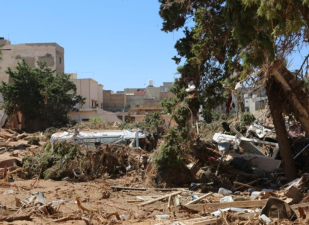
❒ The Destruction of Earthquakes
The earthquake in Aleppo, Syria, triggered by active faulting, killed approximately 230,000 people.
The southern Syrian town of Aleppo lies on the fault line between the Arabian and African plates, specifically the northern part of the Dead Sea Fault. In 1138, a powerful earthquake struck the area, caused by active faulting between the two tectonic plates. This earthquake lasted for nearly a year, causing devastating damage to numerous towns and severely damaging military facilities. It is estimated that this earthquake resulted in approximately 230,000 deaths.
Antioch, Turkey, was affected by a magnitude 7 earthquake, resulting in 250,000 casualties and exacerbating wildfires.
Around biblical time, Antioch in Turkey was struck by an earthquake of approximately magnitude 7. This earthquake caused 250,000 casualties, and subsequent fires further destroyed surviving buildings. For the next year and a half, rescue efforts were severely threatened by aftershocks.
The Gansu earthquake triggered a ground rupture that killed approximately 230,000 people and altered the local geography.
In 1920, Gansu Province was struck by a massive earthquake measuring 7.8 on the Richter scale. The earthquake's destructive power was staggering; almost all buildings were leveled, resulting in approximately 230,000 deaths and becoming another major natural disaster of the 20th century. The resulting ground rupture divided the region in two, forming two cities, with the fault line stretching for 100 miles (approximately 160 kilometers). Furthermore, the earthquake altered river courses, triggered landslides, and buried vast areas of cities and regions, posing unprecedented challenges to rescue efforts.
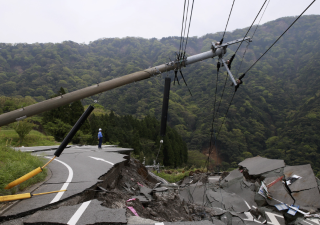
The Aleppo Earthquake:
In 1138, Aleppo was struck by a devastating earthquake. This disaster caused immense damage to the region, destroying countless homes and displacing countless people. This earthquake undoubtedly left a profound mark on human history. Aleppo, a city located north of the Dead Sea, lies precisely at the boundary of the African and Arabian tectonic plates. From October 1138 to June 1139, a series of earthquakes struck the region. The Halim region suffered the most severe impact, with earthquakes resulting in the tragic deaths of approximately 230,000 people. This disaster undoubtedly left an indelible mark on the history of Aleppo and indeed the world.
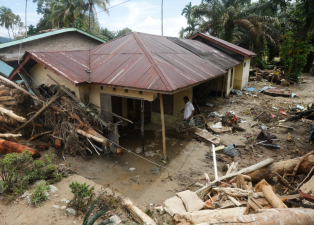
Tangshan Earthquake
In 1976, the Tangshan earthquake struck. Following the breach of the Banqiao Dam, Tangshan was again hit by a massive earthquake. This earthquake dealt a heavy blow to Tangshan, collapsing countless houses and severely damaging infrastructure. Many innocent people lost their lives in this disaster, making the reconstruction of Tangshan exceptionally difficult. The Tangshan earthquake is considered one of the most devastating earthquakes in world history. Its epicenter was located in Tangshan City, Hebei Province, China, a city with a population of approximately one million. The earthquake was extremely destructive, resulting in the tragic deaths of approximately 242,000 people.
❒ The devastating floods
The 9.3 magnitude earthquake triggered a tsunami that affected 11 countries, causing 225,000 deaths, making it the deadliest tsunami in history.
On December 26, 2004, a massive earthquake and tsunami struck the Indian Ocean, shocking the world. The epicenter was located on the seabed north of Sumatra, Indonesia, with a magnitude of 9.3, a truly unprecedented event. The resulting tsunami swept across the coastlines of 11 countries, causing 225,000 deaths and displacing over one million people. This disaster is thus etched in history as one of the deadliest tsunamis.
The cyclonic storm and tidal waves in Kolinga resulted in approximately 300,000 deaths and destroyed the city.
In the late 18th and early 19th centuries, Kolinga was an important port city in India, situated on the banks of the Godavari River. However, on the night of November 25, 1839, a catastrophe struck, triggered by a massive cyclone. A tidal wave reaching 40 feet (approximately 12 meters) swept in, instantly destroying 20,000 ships and causing 300,000 deaths. The once bustling cities were completely obliterated, leaving only desolate villages.
The Bora Cyclone caused flooding at high speeds, and due to weak infrastructure, the death toll is estimated at 500,000.
On November 11, 1970, Bangladesh was struck by Cyclone Bora, widely considered one of the deadliest tropical cyclones in history. It swept across the low-lying areas of the Ganges Delta at speeds reaching 140 miles per hour (approximately 225 kilometers per hour), accompanied by 30-foot (approximately 9-meter) waves, causing devastating flooding. Due to weak local infrastructure, the exact death toll cannot be accurately counted, but it is estimated that this disaster caused as many as 500,000 deaths, making it one of the most devastating natural disasters in modern history.
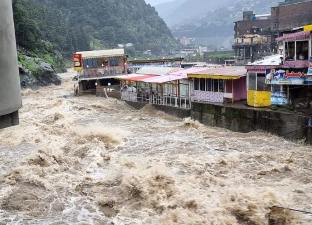
❒ The Devastation of the Flood
The earthquake, estimated to be between 8.0 and 8.5 on the Richter scale, caused approximately 800,000 deaths due to its location in a densely populated area.
On January 28, 1556, a massive earthquake struck Shaanxi Province. At that time, China did not yet have a Richter scale, nor were there official statistics on the death toll. However, historians speculate that the earthquake's magnitude was likely between 8.0 and 8.5, and the resulting fissures reached an astonishing depth of 60 feet (approximately 18 meters). Because the earthquake occurred in a densely populated area, it caused widespread casualties; it is estimated that approximately 800,000 people lost their lives in the disaster, and urban infrastructure suffered devastating damage. Huaxian County, in particular, was a severely affected area near the epicenter, where almost all buildings collapsed, resulting in the death of more than half of its population.